Wednesday, January 3, 2018

Fight Classroom Hunger, but the right way

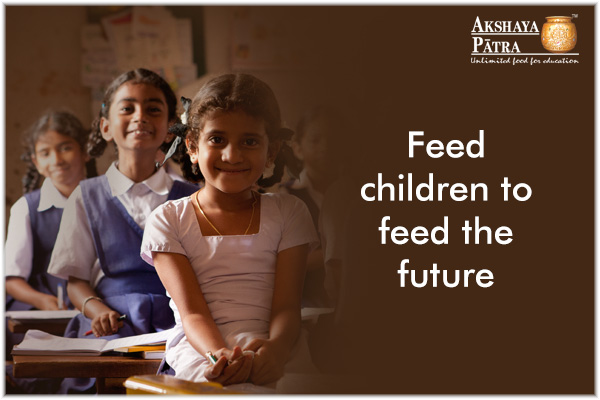
Fighting malnutrition, especially among children, is now a challenge that transcends all classes of society and regions. But, a significant proportion of school-going children in India now need not worry as they are now able to escape the scourge of hunger and malnutrition, thanks to the efforts of The Akshaya Patra Foundation.

The food supplied from the 34 kitchens of Akshaya Patra across the country is not merely cooked to fill the stomachs, but it is a wholesome balanced meal that supplies all the necessary nutrition. The food that the children get in their mid-day meals are fortified with the required nutrients necessary for both physical and mental development of children. The food is fortified with nutrients like vitamin A, B vitamins, vitamin D, folic acid, iodine and iron. Food fortification is done to decrease the occurrence of nutrient deficiencies. It is extremely important for children in their growing years to get these nutrients in their food.

Feed a child

You could play a role in this endeavour by donating for education in India and ensuring that children from across the country benefit, both in terms of their dietary needs as well as their educational needs.

Philosophies driving the kitchens

With its primary aim to supply high quality and safe food from its 34 kitchens, Akshaya Patra has introduced various metrics in every area of its operations and service delivery. It has partnered with different organisations to review the quality of its mid-day meals prepared and served to more than 1.6 million children every day. To maintain the quality of the meal, it has standardised the recipes.

Say Kaizen and 5S, the Japanese business philosophies, and the ones that come into your mind would be corporate majors like Toyota. But, it's part and parcel of Akshaya Patra's kitchen operations. To improve the quality standards, Japanese management technique of Kaizen and 5S, the method of workplace organisation that uses five Japanese words: seiri, seiton, seiso, seiketsu, and shitsuke. They describe ways to organise a workspace for efficiency and effectiveness by identifying and storing the items used. With the Foundation focused on Employee Health and Safety too, it holds activities to increase the hygiene standards and improve safety and health.

A top NGO like Akshaya Patra which has the wherewithal to ensure the food is balanced, can be trusted in ensuring that the children get the right kind of meals. A meal that is not well-balanced would result in children growing up malnourished. A food without the micro-nutrients would affect the mental development of children too and its impact would be visible in adulthood.

Keeping Children healthy

With the government having so many things to focus on, NGOs have a role in ensuring that the ills caused by unhealthy foods are taught to children and their parents to ensure they get the right kind of food.

The Foundation, over the last 17 years, has been continuously trying to reach as many children as possible. Today it feeds over 1.6 million children across 12 states in the country.

Friday, December 22, 2017

Donate to charities like Akshaya Patra to prevent food wastage

In a nation where millions of people do not have access to even clean drinking water, around 25 per cent of the fresh water used to produce food is wasted, it should shock many of us awake if we calculate the astonishing figures. It has been estimated to be equivalent to an average river flowing in India.
An estimate by the US's Department of Agriculture, though the world produces enough food to feed twice the present population, food wastage is behind malnourishment of millions of people across many countries. The number of hungry people in India has increased by 65 million, according to the Food and Agriculture Organisation (FAO). This number is as much as or more than many of the other nations.
One of the NGOs in Bangalore, The Akshaya Patra Foundation, has been making all efforts to minimise the wastage of food in the running of its school lunch programme; starting with the way they are stored, to the way they are cooked and distributed.
Land use
Hundreds of thousands of acres of land are deforested to grow food every year. Approximately, 45 per cent of India’s land is degraded, primarily due to deforestation, unsustainable agricultural practices and excessive groundwater use to meet the demand for food. In the last two years, though, India has retained and increased its forest area by more than 14,000 hectares (second largest after China).
A shocking story is that of the nation having edible oil as its third largest import. But, the wastage of food is said to lead to around 300 million barrels of oil used to produce food ultimately going waste due to the wastage of such food. According to a paper, India is said to waste as much food as that consumed by the United Kingdom.
This is not a palatable statistic when we realise that millions still sleep hungry on the streets
Tackling the Food Wastage
According to the UN body of Food and Agriculture Organisation (FAO), food wastage is fast assuming serious dimensions. According to an FAO statistic, a staggering 1.3 billion tonnes of food is wasted annually.
Many of the social reasons also play a role in this. All the social functions and social joints in India, especially in the northern and central parts, functions such as weddings, the canteens, hotels, social and family functions, households, end up wasting a lot of food.
The money one may spend in buying the food which goes unutilised can be used to sponsor a child instead. It is to be noted that food wastage can cripple a country’s economy much more seriously than we realise.
The world's largest NGO-run mid-day meal programme serves wholesome school lunch to over 1.6 million children in 13,800+ schools across 12 States in India. This amount can be used to feed the starving millions in the country.
One could donate to charity to help causes like the one supported by Akshaya Patra.
While we may not be able to reduce food lost during production, we can certainly reduce food wastage at our personal level.

Tuesday, December 12, 2017

Human Rights Day is Integral to Akshaya Patra


It is important that children enjoy their life to the fullest. It's their birth right, no less than their human right. To enjoy their life to the fullest, it is essential that they are educated.

Education helps them develop the skills and also helps them prepare mentally to gain the most from life. But, this can’t be done with an empty stomach. Because education and food goes hand-in-hand. They need a full stomach meal to develop physical strength as well as to grow mentally. This will help them deal with the challenges in life with ease.

While nutritious food is a necessity, it is a luxury for many. One could donate for education in India by supporting NGO’s like The Akshaya Patra Foundation. This can ensure that your donation is used for the right cause. This way, you along with the NGO, can ensure that the rights of the children are being met.

Rights Protected

On December 10 every year, people around the world celebrate Human Rights Day. The date was chosen to honour the United Nations General Assembly's adoption of the Universal Declaration of Human Rights (UDHR). It is the first global statement of international human rights principles on December 10, 1948.

The day holds importance for those who play a major role in ensuring that all sections of people are able to enjoy a minimal quantum of rights day in and day out. Be it the governments or the NGOs, all play their respective roles to ensure human rights are not violated and are, instead, defended.

It was about 70 years ago that the Universal Declaration of Human Rights was made. Since then, many nations have been in the forefront of the efforts to ensure that human rights are not violated, either of their own people or even of people of other nations.

Right to Food

The right to food is recognised in the 1948 Universal Declaration of Human Rights (Article 25) as part of the right to an adequate standard of living, and is enshrined in the 1966 International Covenant on Economic, Social and Cultural Rights (Article 11).

An NGO like Akshaya Patra, which is considered one of the top NGOs and many others ensure that basic rights of people such as their Right to Food are not violated. From its 34 kitchens in India, the Foundation has been serving nutritious school lunch to over 1.6 million children across the country. This has helped in success of many children who are now able to dream high in life.

It is crucial that non-partisan groups are able to ensure that the rights of children, in particular, are defended. On this World Human Rights Day it's necessary to remember and to remind everyone of the need to and the importance of human rights. It is crucial for the NGOs to play a role in India towards meeting the commitments made on the UN Human Rights Day.

You can also join the cause by making a contribution towards eradicating classroom hunger. Make a donation today.

Wednesday, December 6, 2017

Are we prepared to lead our country towards positive development?

In the Budget 2016, the total allocation to the ministry of Women and Child Development (WCD) was ₹17,408 crore. This included ₹413 crore for funding the National Nutrition Mission, which addresses the maternal and child malnutrition issues.

At present, the government looks after pregnant women in the high-burden districts of India, these districts are defined by their backwardness and their lack of basic facilities. But, the new scheme will be for all families living below the poverty line across the country.

This will ensure that children across the country have equal chances for a healthy growth through access to good and nutritious food.

The Indian demography

India's population that stands over 1.25 billion is expected to become the world's most populous country, overtaking China by 2022. A good percentage of the Indian population, though, does not have access to all the resources are expected to live a very happy and healthy life in the near future. However, currently, the impact of this lack of resources is acutely experienced by the most vulnerable section of the society, the children.

The school lunch provided by The Akshaya Patra Foundation has ensured that no child is deprived of their basic need for nutritious food. Feeding the children is one of chief aims of the Foundation. The main aim is to free a child from the shackles of hunger and help them focus in classroom. A child need not to worry
about a meal.

Power of a full stomach

While a child may be deprived of the required nutrition, it is not just the physical development that would be affected, but also the mental development. A lack of adequate nutrition could affect the intellectual growth because of the less number of micro-nutrients that are necessary for the mental development.


Hence, ensuring adequate nutrition in the food is important not just for an individual, but also for the country as a whole. That is because today's young children are the future of the country. Hence, it's extremely important to feed the children and ensuring they don't have to worry about food, they will be able to focus on their studies alone. And, mentally healthy children would grow up to be healthy adults and for a country to have healthy citizens, this is imperative.

Future Focus

The future is about knowledge economies. To establish a country as a knowledge economy, it's necessary that its citizens are knowledgeable and mentally healthy.

In the knowledge economy, it’s about the intellectual prowess of the citizens of a nation that will define its success. By using the collective intellect of the citizens, India will be able to stand up and grow up to be a rich nation by being able to develop on all fronts.

Akshaya Patra, which plays a role in the intellectual development of the country, is a channel for anyone to contribute towards charity for children who are in need. This will provide you a path to directly play a role in ensuring a bright future for the country.

Wednesday, November 8, 2017

NGOs Can Make Education Better By Introducing Innovative Teaching Methods

Innovative teaching methodologies are the spirit of the times we live in. Be it private institutions, or the government-funded education system, there have been concerted efforts to make teaching as relevant as possible so that they meet the needs of the day.

Brain research has shown that certain methods and approaches can indeed enhance the learning process. By applying innovative learning and engaging techniques to classes is a win-win for both students and teachers.

Education for children

Finding new and innovative methods of teaching is a crucial skill for high school teachers and The Akshaya Patra Foundation is supportive of innovations in education. Apart from different teaching methods, nutritious food also plays an important role in helping children absorb lessons. Over 1.6 million children across 12 states of India are benefitting from the school lunch programme.

Any efforts making education enjoyable for children should not be considered as charity for children. It’s a necessity and it’s the duty of the current generation.

Generational need

The children of today have shown they are capable of doing more than what the school needs them to. It is hence an opportunity for innovations rather than merely speeding up with the syllabus and this might not bear fruit.

Students are now being encouraged to express their opinions and are taught using mediums they are comfortable with. Rather than being stuck to their chairs, teachers are now nurturing tomorrow's leaders, rather than mere robots.

The transition is not going to be easy as education is a state subject and hence each state has to do more with less. However, this is not a suitable model for educational institutes, especially today when students are more dependent on technology.

But for advancements to be introduced successfully, stronger incentives need to be given.

Different Measures

One of the ways these two concepts can come together is through the Bond Measure. It is a method that creates innovative learning environments by re-thinking school designs. The ideas can provide students a thriving and fertile ground for their own ideas by providing them flexible spaces that can support a range of learning styles.

Such environments can foster learning and offer students choices on the type of education they prefer. This is in concurrence to what is called an Opportunity Culture, and it is different from traditional modes of education and school structures. This concept uses age and job redesign and technology suitable for the young minds.

The successful teachers are educationists who ensure enough progress each year to close the achievement gaps and who allowed their students to make significant progress.

Besides increasing the reach of influential instructors, this innovative culture also opens new channels of learning for the teachers themselves. Here there’s a Role of NGOs in ensuring that the new methods of teaching and learning are accessible even to the economically-challenged sections and is not restricted to the upper echelons of the society.

Most of the jobs that result from the Opportunity Culture are team-based and they also provide teachers school daytime planning and associations they need on a priority basis. In addition, this teaching culture can result in massive cost savings, which can go to paying excellent teachers the amount they are worth.

In the new methods of teaching, teachers can become leaders in the classroom rather than just instructors while leading multi-classroom teams and aiding students in developing their individual skills.

This, in turn, can motivate them to go above and beyond the call of duty to aid their students in becoming the best version of themselves, a concept that is the complete opposite of what traditional and arcane education represented.

Along with innovative teaching methodologies, pledge to feed the children with wholesome meal. Also enjoy tax exemptions. Donate today.