Showing posts with label education for children. Show all posts

Friday, April 13, 2018

An NGO's effort to make health is wealth for children

NGO for Children

‘Health is wealth’ is a familiar phrase and it becomes even more important with respect to children. The first five years of a child is considered to be the most crucial growth phase as a significant amount of development and learning happens during these formative years. And, an important aspect that promotes healthy growth is consumption of nutritious diet. Nutrition improves cognitive functioning, appropriate physical development, maintains energy levels, and provides enhanced immunity against infections and diseases. And, there is enough evidence to establish the relationship between nutrition, health, and learning.


So that every child receives the best of nutrition, many NGOs have taken it up as their core cause to provide wholesome meals to children mainly targeting the lower socio-economic strata of the society. One such NGO for children in India is The Akshaya Patra Foundation. Established in June 2000, this NGO implements the Mid-Day Meal Programme in government schools across the country with the vision ‘No child in India shall be deprived of education because of hunger’. For the past 17 years, the Foundation has been tirelessly working towards providing freshly cooked, nutritious school lunch to school children so that children continue schooling and at the same time benefit from the programme health-wise. Before talking further about this NGO and its work towards promoting health and education, here is a list of reasons that explains the significance of investing in nutrition, health, and education of children:


Thus, it is evident that nutrition, health, and education become critically important during the growth years of children.

Well, heeding to the above-mentioned aspects of nutrition and health, Akshaya Patra, the NGO for children strives to provide ‘unlimited food for education’. In order to maximise the benefit of the Mid-Day Meal Programme, Akshaya Patra operates to formats of kitchen facility – centralised kitchen to provide school lunch in urban and semi-urban areas, and decentralised kitchens to provide school lunch in remote areas. To ensure meals are nutritious, the NGO employs various quality measures in its operations – right from procurement of raw materials to delivering the cooked meals. Raw materials are procured based on Supplier Quality Management System and are inspected as per Food Safety and Standards Authority of India (FSSAI). All the kitchens follow the FIFO (First In First Out) and FEFO (First Expiry First Out) methods while issuing the raw material for production. Washed and sterilised vessels and tools are used for cutting, cooking and transporting food. All employees are trained in good hygiene practices and food safety measures. It is mandatory for each member in the kitchen to follow the hygiene chart comprising of daily shower, use of clean uniforms, head caps, face masks to cover the mouth and nose area, hand gloves, gumboots, other protective gears and hand sanitisation. Cooked food is transported in insulated vehicles to retain the freshness and quality of meals. Continual Improvement Projects, Six Sigma methodologies, 5S, GMP, Lean and Kaizen are some of the process improvement methods implemented across all kitchens.

This charitable trust understands the value of each penny and hence on an average, 92% of the total donation is used towards meeting the programme cost and 8% towards the programme management cost. Such effective management of funds and operations has led the Foundation to grow steadily over the years. From feeding just 1,500 children in five government schools of Bengaluru in 2000, Akshaya Patra has expanded its reach to more than 1.7 million children across 12 states of India. It has impacted young lives with wholesome meals on every school day. So, even though Akshaya Patra is a mid-day meal NGO, it wouldn’t be wrong to say donate for education in India because its service of 17 years has been instrumental in bringing children to school and empowering them with education.

In a nutshell, to create a healthy society, we must focus on the health of children. And, to create a prosperous society, we must focus on the education of children. Only healthy children can contribute to the socio-economic growth of themselves and the society.

Wednesday, November 8, 2017

NGOs Can Make Education Better By Introducing Innovative Teaching Methods

Innovative teaching methodologies are the spirit of the times we live in. Be it private institutions, or the government-funded education system, there have been concerted efforts to make teaching as relevant as possible so that they meet the needs of the day.

Brain research has shown that certain methods and approaches can indeed enhance the learning process. By applying innovative learning and engaging techniques to classes is a win-win for both students and teachers.

Education for children

Finding new and innovative methods of teaching is a crucial skill for high school teachers and The Akshaya Patra Foundation is supportive of innovations in education. Apart from different teaching methods, nutritious food also plays an important role in helping children absorb lessons. Over 1.6 million children across 12 states of India are benefitting from the school lunch programme.

Any efforts making education enjoyable for children should not be considered as charity for children. It’s a necessity and it’s the duty of the current generation.

Generational need

The children of today have shown they are capable of doing more than what the school needs them to. It is hence an opportunity for innovations rather than merely speeding up with the syllabus and this might not bear fruit.

Students are now being encouraged to express their opinions and are taught using mediums they are comfortable with. Rather than being stuck to their chairs, teachers are now nurturing tomorrow's leaders, rather than mere robots.

The transition is not going to be easy as education is a state subject and hence each state has to do more with less. However, this is not a suitable model for educational institutes, especially today when students are more dependent on technology.

But for advancements to be introduced successfully, stronger incentives need to be given.

Different Measures

One of the ways these two concepts can come together is through the Bond Measure. It is a method that creates innovative learning environments by re-thinking school designs. The ideas can provide students a thriving and fertile ground for their own ideas by providing them flexible spaces that can support a range of learning styles.

Such environments can foster learning and offer students choices on the type of education they prefer. This is in concurrence to what is called an Opportunity Culture, and it is different from traditional modes of education and school structures. This concept uses age and job redesign and technology suitable for the young minds.

The successful teachers are educationists who ensure enough progress each year to close the achievement gaps and who allowed their students to make significant progress.

Besides increasing the reach of influential instructors, this innovative culture also opens new channels of learning for the teachers themselves. Here there’s a Role of NGOs in ensuring that the new methods of teaching and learning are accessible even to the economically-challenged sections and is not restricted to the upper echelons of the society.

Most of the jobs that result from the Opportunity Culture are team-based and they also provide teachers school daytime planning and associations they need on a priority basis. In addition, this teaching culture can result in massive cost savings, which can go to paying excellent teachers the amount they are worth.

In the new methods of teaching, teachers can become leaders in the classroom rather than just instructors while leading multi-classroom teams and aiding students in developing their individual skills.

This, in turn, can motivate them to go above and beyond the call of duty to aid their students in becoming the best version of themselves, a concept that is the complete opposite of what traditional and arcane education represented.

Along with innovative teaching methodologies, pledge to feed the children with wholesome meal. Also enjoy tax exemptions. Donate today.

Wednesday, May 17, 2017

Why every child should be given a fair chance

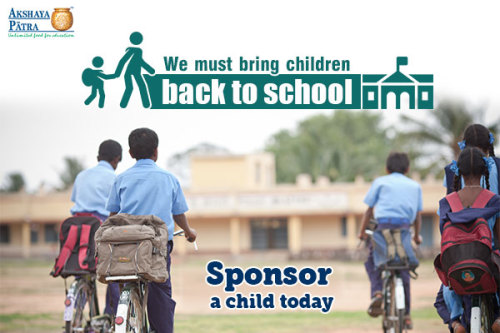
As George Orwell’s once penned down that ‘Some are more equal than others,’ we are beginning to realise how much inequality affects children. There is an evident inequality of income and opportunities in general affecting all age groups. While we all strive towards equality, can we not forget the children who deserve a fair chance to be in school? Today, we would like to talk about why we should bring children back to school!

Back to school

Millions of children today need food and education. They battle with inequities on a day-to-day basis. Many credible reports state that if we don’t tackle the inequity at various levels today, millions children of primary school age will be out of school. Good news is we can do something now through various charity donations or non-profit fundraising ideas of helping children go to school. 

Every child deserves a fair chance to grow, explore life and learn from his surroundings, from school and the environment. Here’s why – 

A fair chance gives the child space to grow

Every child is built uniquely with his/her own set of aspirations, dreams, background and perspectives. A lot of times children can totally stump you with their understanding. Other times they may charm you with their innocence. Children therefore must be nurtured with a natural sensitivity towards their environment and background. 

A fair chance ensures natural exploration

It’s only when each child is given a fair chance is he/she able to explore knowledge and life with much freedom. Many top NGOs such as Akshaya Patra are working hard to provide this kind of natural nourishment so children learn to have a neutral stand about things around them and make choices on their own. 

A fair chance is necessary for a broad perspective

The adolescent years contain crucial lessons and have a deep impact on the rest of their lives. When children are given a fair chance to grow, they get a broader perspective about life. They grow up to become sensitive citizens who are aware of what’s important for the growth of the society.

A fair chance paves way for education

Learning is an integral part of any child’s growing up years. When children are given equal opportunities to study and learn, they are able to pick up vital lessons for life along the way. Akshaya Patra encourages charity donation in order to run its mission of serving wholesome lunch to school children so they are incentivised to attend their schools regularly and get a chance to study. 

A fair chance gives them a healthy growth

When children have equal resources for physical and mental nourishment, they grow up without grudge against their circumstances. This is very important for their healthy growth. This way they are able to focus their energies towards issues such as education, awareness, emotional intelligence and respect towards others. 

There are several children charities activities that you may initiate from your end towards the cause of giving children a fair chance of growth. One of the ways is definitely to help children get wholesome lunch so they are encouraged to come to school. We urge to join hands with one of India’s top NGOs - Akshaya Patra.

Tuesday, March 21, 2017

This Summer, Connect with Children and Gift Them a New Academic Year!

When you were in school, how did your summer vacation begin? It would probably begin with you saying goodbye to your friends and classmates but with an expectation that you would see them again. The holidays are fun and exciting but it is also nerve-racking to go back to school for the next level. While this is the norm, there are many children in India who do not get the opportunity to return to school. In other words, they drop out of school due to economic instability.


What causes children to drop out of school?

In this article, we have highlighted two issues (among many factors) that cause a child to drop out of school. While majority of children drop out due to migration, there are children who drop out of school due to financial difficulties in the family. 

(i) Migration: Also means relocation. For example, if and when the family moves to a different city or town on work prospects, they get their child enrolled in a school. After the work contract is complete, the family may decide to move to another town in search of income. This directly affects the child who is (not in all cases) forced to drop out of school before completing the academic year. In another scenario, although the child has completed the academic year, he or she does not get the opportunity to return to the same school. 

(ii) Financial Security: One of the main reasons for a child to drop out of school is because they would like to look out for other prospects; prospects that can help their family financially. School lunch programme has proved to stabilize these families as one meal is guaranteed for the child. Mid-day meal encourages children to continue education while their one square meal is taken care of.

These issues can affect children during the learning phase and in the future. According to MHRD report for 2014-15, the dropout rate for primary level was 4.34 per cent. Although there has been a drastic decrease in drop out and increase in enrolment rate, we need to change the situation for 4.34 per cent of children. To resolve these issues, the government has brought into effect several schemes and one of them is Mid-Day Meal Programme. Working along with government, Akshaya Patra’s Food for Education initiative has been reaching out to millions of school children every day. This NGO in Karnataka began its mid-day meal operations in Bengaluru in the year 2000. In 2016, the Foundation completed the serving of 2 Billion mid-day meals and this milestone was acknowledged by the President of India, Shri Pranab Mukherjee. 

You can show your support by donating to charity and sponsoring a child for a year! By contributing to Akshaya Patra, you will also receive 100% income tax exemption.